

Clinic Report: Melissa Allen Dressage
As much as I enjoy showing, I’ve been focused for the last year on improving my effectiveness as a rider and supporting that growth with 1 clinic each quarter. Last weekend, I rode with Melissa Allen for two days and focused on straightness, getting a better feel for the tempo of the gaits and more consistent connection.

Melissa is based in Kansas City, Missouri and connected with my trainer last year at Nationals. Our assistant trainer has ridden with her before and highly recommended her, so after being impressed with how she coached students at Nationals a clinic was scheduled here in Texas. Melissa is a USDF Bronze, Silver and Gold Medalist and has pursued USDF Instructor Certification up to the FEI level.
I was hopeful going into the clinic that Elf’s recent improvement in work ethic would allow for a more productive clinic than some we’ve had in the past. Of course, just for fun, I also found myself down with pneumonia for the two weeks before the clinic and barely able to ride. I managed one lesson on Thursday to help get his brain back and hoped for the best.
A bonus when we have clinics here at Salado Creek Riding Club is that I am able to photograph them. It’s fun to be able to offer the other riders those images, but I also find that I get so much more out of clinic when I’m shooting it because I’m paying such close attention to the rider while listening to the clinician so I know where to move to. Because it gives me something to focus on, I see little things that I miss when I’m not shooting.
Start With Forward
Throughout Saturday morning, Melissa spoke frequently about getting forward movement before addressing anything else. “If you’re driving a car, and you put your hands on the steering wheel and turn it, you’ll turn your tires. But if you press the gas, first, then turn the wheel you’ll actually get movement in that direction. ” It was clear from the get go that Melissa’s teaching style is quietly insistent. From training level riders on up, she focused on clear and effective aids supported by correct rider body position.
It’s My Trot
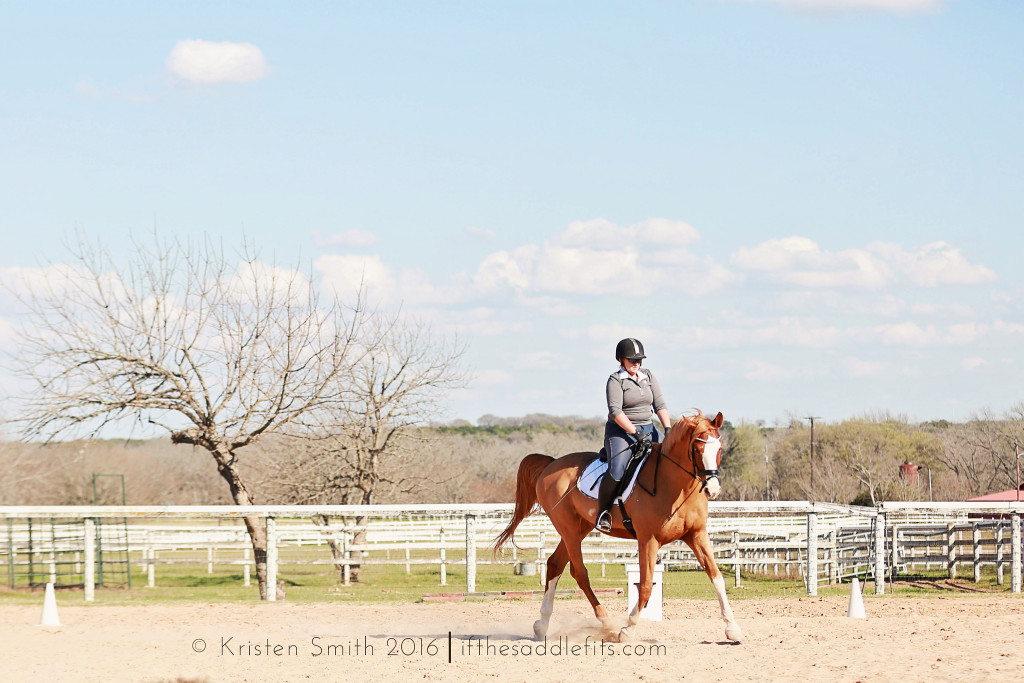
My ride on Saturday was at 3:15, which took a little management as the barn employees would start feeding dinner in the middle of my ride. For whatever reason, Elf is intensely focused on the Gator that they use to bring the hay around and it’s caused more than one melt down in the past. So, he came in from turnout a little early and was fed his dinner at 2. He seemed okay with this situation and didn’t seem bothered by the Gator.
In our initial chat, I told Melissa that we’d been working on submission, strengthening Elf’s back & hind end and being able to move through transitions and in and out of movements without a fight.
From the get go, the focus was “follow the leader” – with me being the leader. One of Melissa’s favorite mantras is “make it YOUR walk/trot/canter” to remind the rider that it is our responsibility to decide both the tempo and the reach of whatever gait we are working. Fortunately, one challenge that we seem to have a good handle on this year is keeping Elf in front of my leg. The connection isn’t always there yet, but his gas pedal is much better than a year ago. With forward established, we worked on bringing him to the outside rein. I’ve struggled a bit with not throwing away my outside rein by bringing my shoulder up, forward and rounding it. I can tell when that’s happening immediately because it means I’m using my forearms and biceps instead of my core and back. Taking a deep breath, sinking into the saddle and rolling my shoulders back meant an engaged outside rein every time. On the circle tracking right, it helped to think of stepping into my outside stirrup just a little when I brought my shoulder back. This created a subtle, thinking-of-leg-yield aid that helped to keep Elf straight on the circle, stepping up and out with his inside hind, and flexed through his barrel. Elf is one of those horses whose gaits dramatically improve when he’s using himself correctly (so it’s painfully obvious when he’s not) so it provides near instantaneous feedback when I lost either my position or the connection.
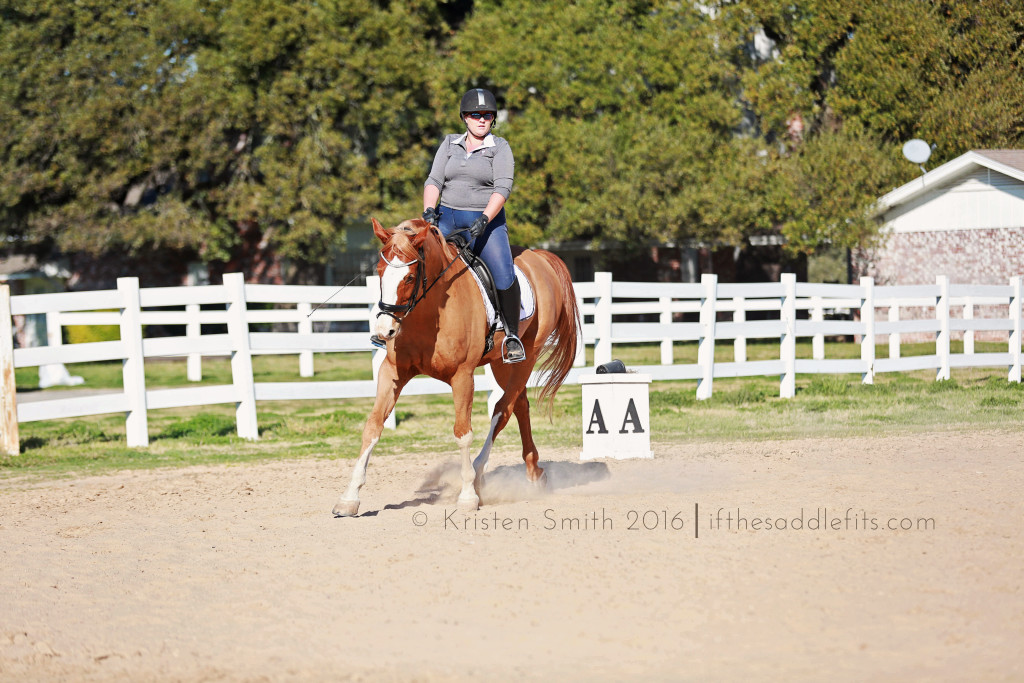
Next up was softening the jaw. I’d say that Melissa is a minimalist when it comes to the aids. There is no nagging here. Aids are prompt, firm and the expectation is that they are listened to NOW. Your horse blows through that aid? Change what you’re doing to set them up for success.
Throughout the lesson, this was repeated:
- Check my position: core engaged, sitting evenly on both seat bones, legs long with the seat indicating the tempo I want in the gait.
- Hands to “home base” (find that thought on Melissa’s Training Tips page)
- Forward into the outside rein.
- Soften the jaw, flexing to the inside by massaging with the inside hand’s ring finger.
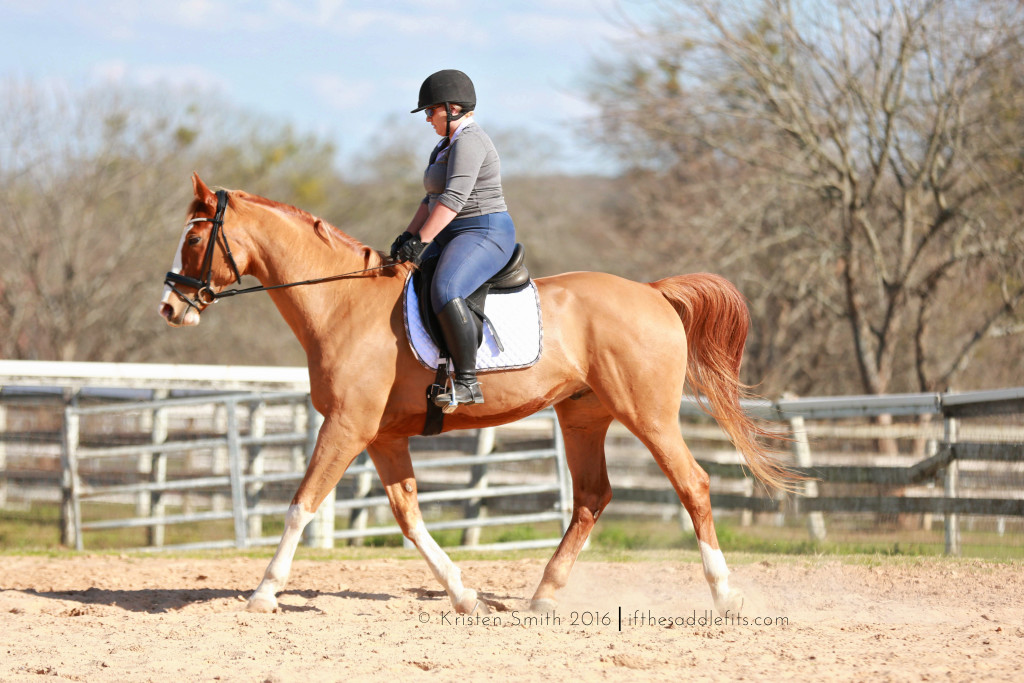
After checking straightness by going down the quarter line, Melissa asked me to put my inside knee into saddle and step into my outside stirrup – magical leg yield with no fight. We’re going to need to refine to make sure he’s bringing the haunches but, again, Elf proved that if I can take away the fight and ride him largely off the seat his sensitivity becomes a good thing.
I was incredibly pleased with Elf’s Saturday lesson. Not a single melt down, he kept his brain turned on and he felt with me and fluid.
Raising My Expectations
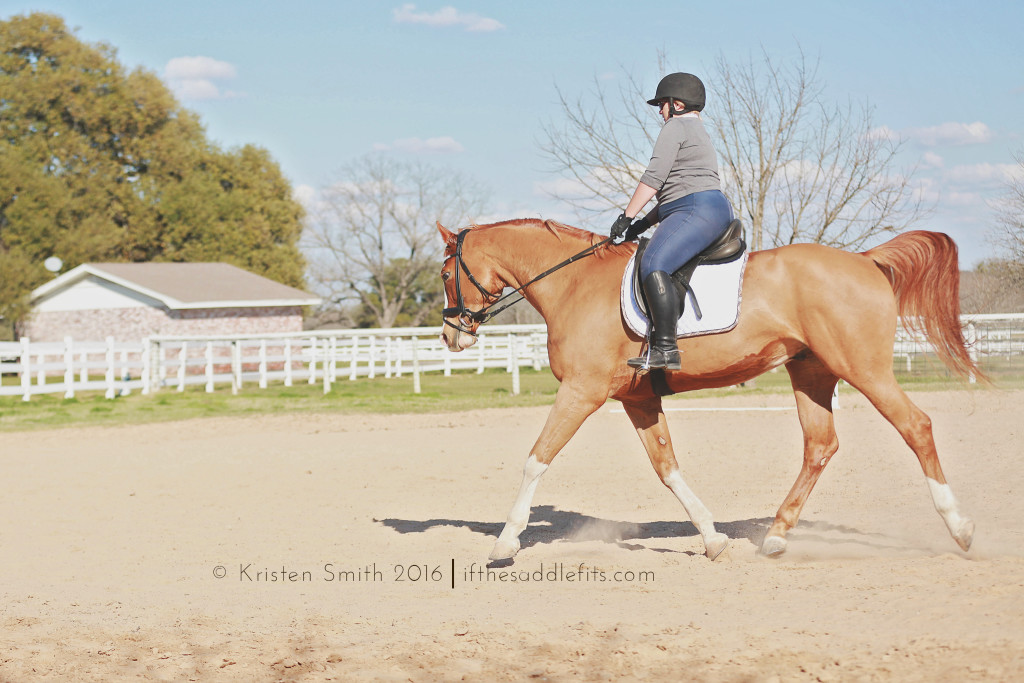
I knew Day 2 was going to be a different kind of ride. It was cooler and we rode earlier plus I knew he’d be sore from working hard (which does not improve the big Elf’s mood AT ALL). Right from the start, this proved to be true when he attempted his trademark spin-and-exit-the-arena. But he got back on track quickly and went to work (grumpily). We started with that same check: position, my tempo, forward to the outside rein and soften the jaw. We moved around the arena more on Day 2, with more transitions.
Essentially, day 2’s ride offered more opportunities to lose that connection and tempo we worked on building in day 1. Melissa was very deliberate about working through tools to see what worked. Transitions, using the quarter line to check straightness, setting the size of the stride with my seat and slowing the tempo to prevent his panicky response.
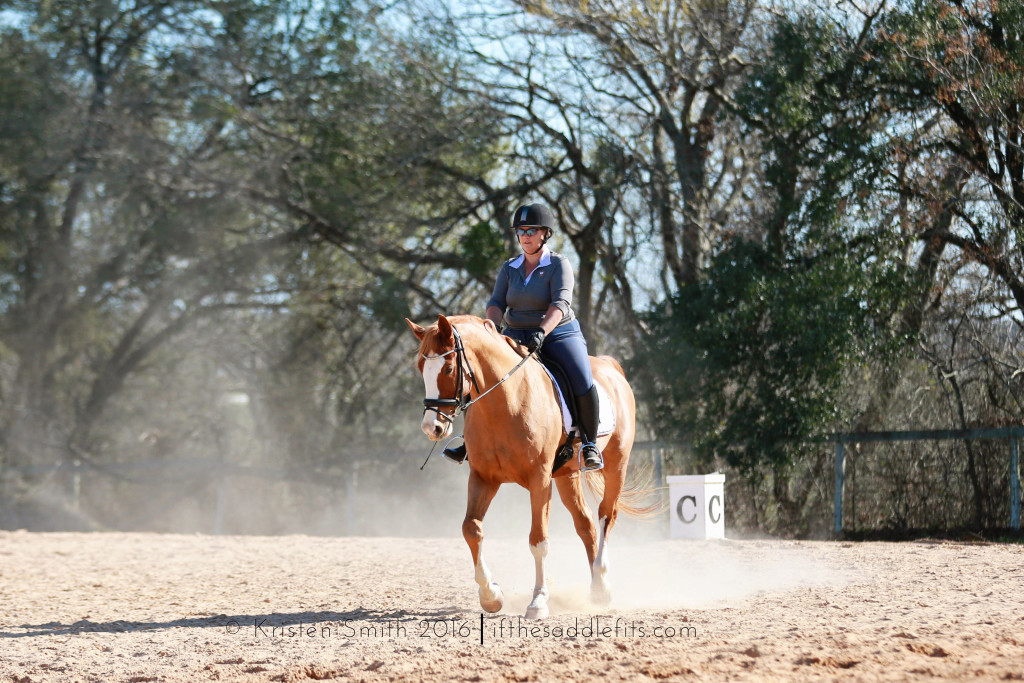
We did an exercise that I’d already done with my trainer – going across the diagonal and changing to a leg yield at the quarter line. What we changed with Melissa was how I asked for the leg yield. It is a softer aid and more focused on asking him to shift to stay with me than asking for the sideways movement with my leg. It seems to have largely eliminated the panicky, throw up the head and fight that every leg yield started with.
We finished day 2 with trot-halt-trot transitions, which are a challenge for him. Maintaining the forward momentum into the halt so that he doesn’t lurch back into movement is a big ask still. Here, like everything else with Elf, it comes down to raising my expectations and making them black and white for him. He has to understand exactly what I want at each moment and see that there isn’t an alternative. For him, taking away the choice makes the ride calmer and eliminates much of the frantic-ness that often happens when we work on something hard.
Looking forward
All of the exercises we worked on were helpful. But more than anything else, the light bulb was having a ride that didn’t have any fights. I honestly didn’t know if that was possible with Elf. It reinforced that I need to find ways to introduce new, hard things in a way that makes my expectations really clear. When he gets confused, he gets strong and picks a fight. I’m looking forward to applying that homework and riding with Melissa again.


Sounds as though it was a really productive lesson for you! Elf looks like such a sweetheart 🙂
It was, thank you! And he is most of the time 😉
Love all the gorgeous pictures of you two.
Thank you! I am fortunate that my trainer decided to step in and photography my ride since I had photographed everyone else!